Desktop
Requirements
Before you start, you must complete the Clients repository setup instructions, as well as install the Desktop Native dependencies.
- Windows
- macOS
- Linux
These are available as additional dependencies in the Visual Studio Installer.
- Visual C++ Build tools. The newest supported version of Visual Studio can be downloaded here, use the "Community" download link for the current channel. Launch the installer and ensure the workload "Desktop development with C++" is selected.
- Xcode Command Line Tools
- The following packages
build-essentiallibsecret-1-devlibglib2.0-dev
We now recommend using Nx commands for building projects. For desktop:
# Build and serve (including the native module)
npx nx serve desktop
For complete Nx documentation and all available commands, see Using Nx to Build Projects.
Build native module
The desktop application relies on a native module written in rust, which needs to be compiled
separately. This is baked in to the build process for npm run electron, but you can also compile
it manually. See Desktop Native for more information.
cd apps/desktop/desktop_native/napi
npm run build
Note: This module needs to be re-built if the native code has changed.
Cross compile
Windows on ARM
If you're building in Windows on ARM, you might need to run build.js with the cross-platform
argument to build both arm64 and x64 native binaries:
node desktop_native/build.js cross-platform
Linux & others
In certain environments such as WSL (Windows Subsystem for Linux), it might be necessary to
cross-compile the native module. To do this, first make sure you have installed the relevant rust
target. See rustup documentation for
more information.
# Ensure cargo env file is sourced.
source "$HOME/.cargo/env"

cd apps/desktop/desktop_native
export PKG_CONFIG_ALL_STATIC=1
export PKG_CONFIG_ALLOW_CROSS=1
npm run build -- --target x86_64-unknown-linux-musl # Replace with relevant target
Targeting Windows Appx from macOS
The Windows Appx can be built from macOS1. This can be helpful if you have a macOS development machine and an underpowered Windows test machine, like a VM or test laptop.
(Note: If you are using a Windows VM on macOS with Apple Silicon, we recommend using UTM with a Windows 11 arm64 build for the best performance.)
Prerequisites
- PowerShell 7.x: Build scripts
- makemsix from microsoft/msix-packaging: Packages the file in an Appx
- osslsigncode: Produces signatures in the Appx format using OpenSSL.
- cargo-xwin: Used to cross-compile native binaries for the Windows MSVC target.
You can install these with the following script:
brew install powershell iinuwa/msix-packaging-tap/msix-packaging osslsigncode
cargo install --version 0.20.2 --locked cargo-xwin
Our build scripts will also automatically attempt to install these utilities when cross-compiling to Windows from macOS.
Before building the first time, you must generate a signing certificate and set up your test machine to trust it. See the setup instructions in the Microsoft Store docs for more information.
After that, you can build the Appx from macOS using the steps below.
Cross-compiling Appx
cd apps/desktop
export CERTIFICATE_PASSWORD="<password>"
./scripts/appx-cross-build.ps1 -Architecture arm64 -CertificatePath "<path to signing cert>.pfx"
Once complete, you can copy the Appx file from apps/desktop/dist/Bitwarden-<version>.appx to your
Windows test machine and install it there.
Use PowerShell's help system to get more information about the script arguments:
Get-Help ./scripts/appx-cross-build.ps1 -Full
Build instructions
Build and run:
cd apps/desktop
npm run electron
Debugging
See Debugging with VS Code for how to attach the VS Code debugger to the main and renderer processes.
Biometric unlock (Native Messaging)
Instructions for configuring native messaging (communication between the desktop application and browser extension) are located in the Browser section.
Troubleshooting
Trouble building
If you see an error like this:
[Main] Error: Cannot find module '@bitwarden/desktop-native-darwin-arm64'
You likely haven't built the native module, refer to Build Native Module.
Desktop electron app window doesn't open
If running npm run electron throws an error similar to this:
[Main] npm ERR! Error: Missing script: "build-native"
or the electron window doesn't render, you may need to update node and/or npm. Upgrading from older versions to these solved this issue:
- Node:
16.18.1 - npm:
8.19.2
Windows build installation fails
When installing standard/beta builds (not portable) for the Windows platform from build artifacts, there are additional steps required. Without following the steps, the following failure occurs:
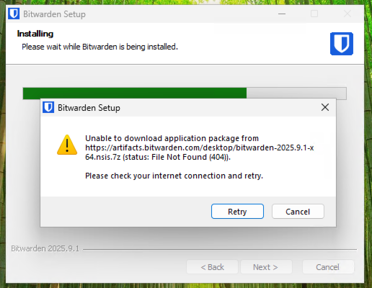
Steps:
- Download the standard / beta Windows build (the
.exefrom figure below) - Download the corresponding
.nsis.7zfile (also seen in figure below) - Place the
.nsis.7zfile in the same directory as the installer (this might require decompressing the download)
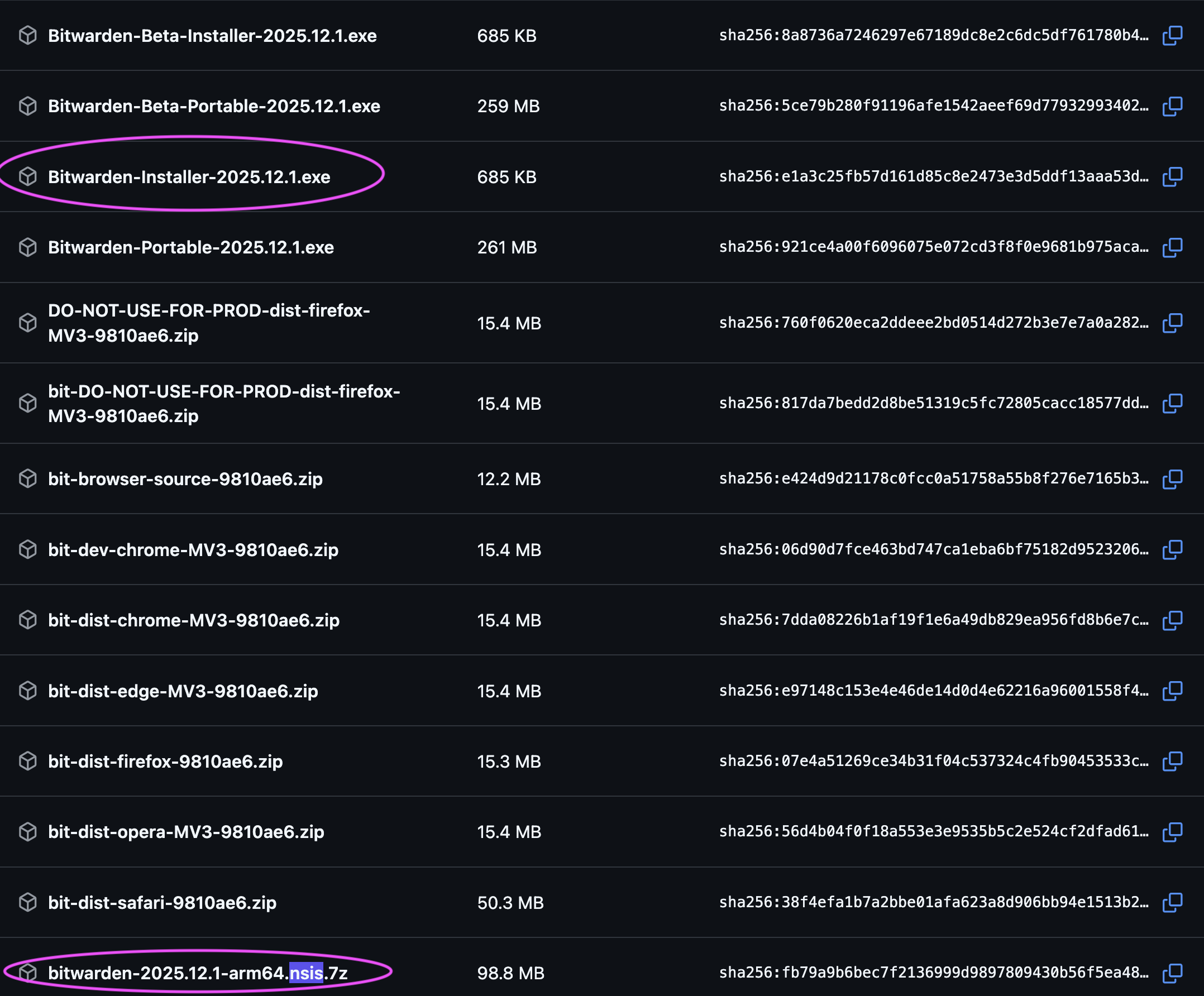
The final directory state before starting the install should look like this:
